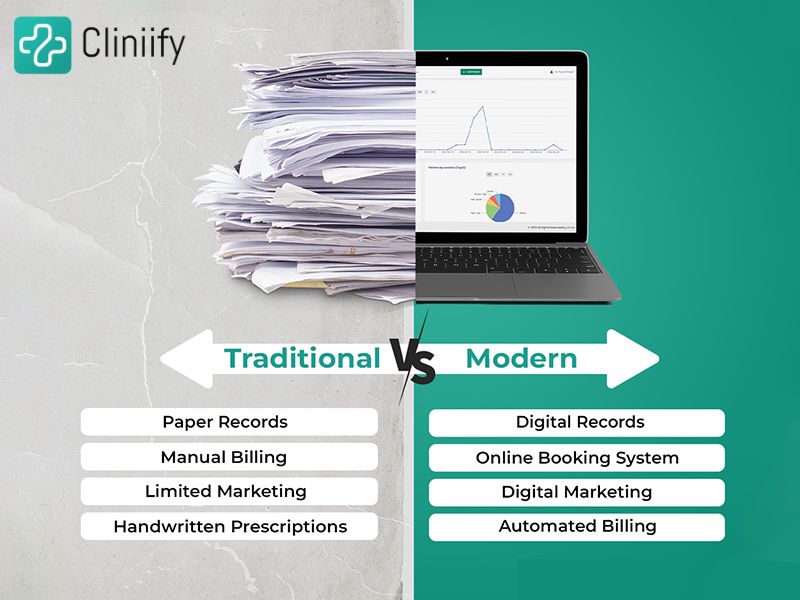
Digital EMR vs Paper Records: Which Is Better for Clinics in 2026?
In 2026, clinics are expected to deliver faster, safer, and more personalized healthcare than ever before. However, many clinics still rely on traditional paper records to manage patient information. This creates delays, increases errors, and limits growth.
The debate of Digital EMR vs Paper Records is now more relevant than ever. With AI-powered clinic management systems becoming mainstream, clinics must decide whether to stay with outdated paper files or switch to modern Digital EMR solutions.
This blog compares both systems in detail to help clinics make an informed decision.
What Are Paper Records in Clinics?
Paper records are physical files that store patient details such as medical history, prescriptions, lab results, and visit notes. While they were once the standard, paper records are now becoming a bottleneck for clinic efficiency.
Limitations of Paper Records
- Easy to lose or damage
- Requires physical storage space
- Time-consuming to update and retrieve
- No backup or recovery system
- High chances of human error
In today’s fast-paced healthcare environment, these drawbacks slow down clinic operations.
What Is Digital EMR?
Digital EMR (Electronic Medical Records) is a software-based system that stores patient data electronically in a secure cloud environment. Doctors and staff can access records instantly from any authorized device.
Key Features of Digital EMR
- Centralized digital patient records
- Secure cloud storage with backups
- AI-assisted clinical documentation
- Fast search and data retrieval
- Automated reports and analytics
Digital EMR systems are designed to improve both clinical accuracy and operational efficiency.
Digital EMR vs Paper Records – Detailed Comparison
Time & Efficiency
- Paper Records: Doctors spend time searching files and manually writing notes.
- Digital EMR: Patient records are accessible instantly with automated documentation.
- Winner: Digital EMR
Data Security & Privacy
- Paper Records: No access control, no backups, high risk of loss.
- Digital EMR: Encrypted data, role-based access, cloud backups, and 2-factor authentication.
- Winner: Digital EMR
Cost & Maintenance
- Paper Records: Ongoing costs for printing, storage, staff handling, and replacements.
- Digital EMR: Subscription-based but reduces long-term operational expenses.
- Winner: Digital EMR
Quality of Patient Care
- Paper Records: Incomplete data and unclear handwriting can affect treatment quality.
- Digital EMR: Complete patient history and AI insights improve clinical decisions.
- Winner: Digital EMR
Reporting & Analytics
- Paper Records: Manual reporting is slow and inaccurate.
- Digital EMR: Real-time reports on patient trends, revenue, and clinic performance.
- Winner: Digital EMR
Role of AI in Digital EMR 2026
In 2026, Digital EMR goes beyond basic record-keeping. AI-powered EMR systems help clinics with:
- Automated clinical notes
- Smart treatment suggestions
- Predictive patient insights
- Reduced administrative workload
This level of intelligence is impossible with paper-based systems.
Why Clinics Are Switching to Digital EMR in 2026
Clinics are adopting Digital EMR to:
- Improve workflow efficiency
- Enhance patient experience
- Enable multi-clinic management
- Support teleconsultation and mobile access
- Scale operations smoothly
Digital EMR has become essential for clinics that want to stay competitive.
Challenges of Using Paper Records in the Future
Clinics still using paper records may face:
- Slower patient handling
- Poor data security
- Difficulty meeting compliance standards
- Lower patient satisfaction
- Limited growth potential
Paper-based systems are no longer future-ready.
Final Verdict – Which Is Better for Clinics in 2026?
When comparing Digital EMR vs Paper Records, the conclusion is clear. Paper records belong to the past, while Digital EMR represents the future of healthcare.
Digital EMR offers better efficiency, security, accuracy, and scalability — making it the smarter choice for clinics in 2026.
Ready to move beyond paper records?
Cliniify’s AI-powered Digital EMR helps clinics manage patient data securely, save time, and deliver better care.
- Cloud-based & secure
- AI-assisted documentation
- Easy for doctors & staff
- Ideal for clinics & dental practices
Book a free demo today and experience smarter clinic management with Cliniify.